Request Pilot Project
Book Free Demo
Road + Waste Infrastructure Monitoring · India

AI Pothole & Garbage Detection — One Platform for Smart Cities & Campuses

Manual inspections miss both India's potholes and its garbage. Tentovision's AI pothole and garbage detection platform detects road damage and waste from existing CCTV, vehicle-mounted cameras, or patrol dashcams — classifying severity, geo-tagging every location, and alerting maintenance teams in real time. One platform for road health and waste compliance, built for municipal corporations and private campuses alike.

Real-TimeDetection
Geo-TaggedWard mapping
ExistingCameras
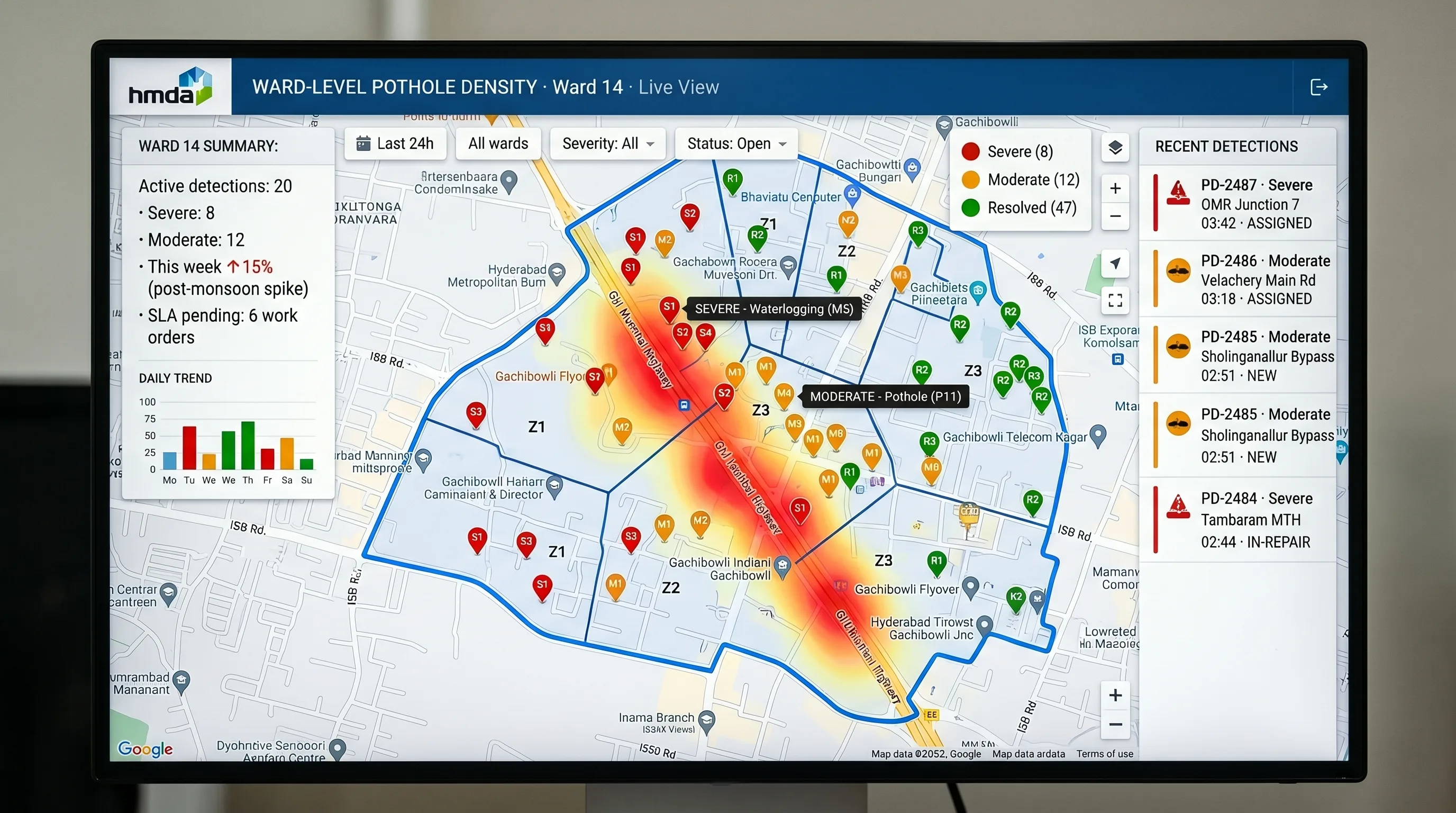
Hero image — Road + waste dashboard mapping
(pothole + garbage pins, ward filter, severity colours)
Tentovision road and waste dashboard mapping pothole and garbage detections across a city
Works on Existing Cameras
Geo-Tagged & Ward Mapping
No Per-Bin Sensors
Microsoft Azure India
VAPT Aligned
The Problem

Why India's Roads and Waste Need AI Monitoring

Two crises, road and waste, share one root cause: monitoring that depends on human eyes that cannot scale. (Figures shown are reported estimates pending source verification.)

The Pothole Crisis

Government — 500 km, inspected by hand

India reportedly loses 14,000+ lives a year to accidents linked to poor roads, yet manual inspection covers barely a tenth of the network — an engineer managing 500 km might inspect 20 km in a week. Damage is found only after an accident or a flood of citizen complaints.

Private — damage found when a car is

On IT parks, industrial estates, and townships, internal road damage goes unreported until an employee's car is damaged or a visitor complains — because no facility manager has time for a daily walkthrough of a 40-acre campus.

The Garbage Crisis

Government — no way to verify pickups

Despite the Swachh Bharat Mission's reported ₹1.4 lakh crore investment, illegal dumping persists, bins overflow between cycles, and contractors skip pickups with no automated way to verify — sanitation still leans on complaints and manual supervisor checks.

Private — SLA compliance is contractual

A hospital must prove its biomedical-waste zones are monitored; an IT park needs cleanliness scores for LEED/IGBC; a mall needs SLA proof against its housekeeping vendor. Manual walkthroughs with paper checklists don't scale to any of it.

Definition

What is AI-Powered Pothole & Garbage Detection?

AI pothole and garbage detection is a computer-vision system that automatically spots road damage and waste accumulation from CCTV or vehicle-mounted cameras, classifies severity, geo-tags the location, and alerts maintenance teams in real time — replacing manual road surveys and sanitation walkthroughs with continuous, automated monitoring across a city or a campus.

The approach is camera-based, and that's the defining choice. The same system runs on fixed CCTV (junction, traffic, building-mounted), on cameras mounted on patrol cars and garbage trucks, and on ordinary dashcams — feeding one AI engine and one dashboard.

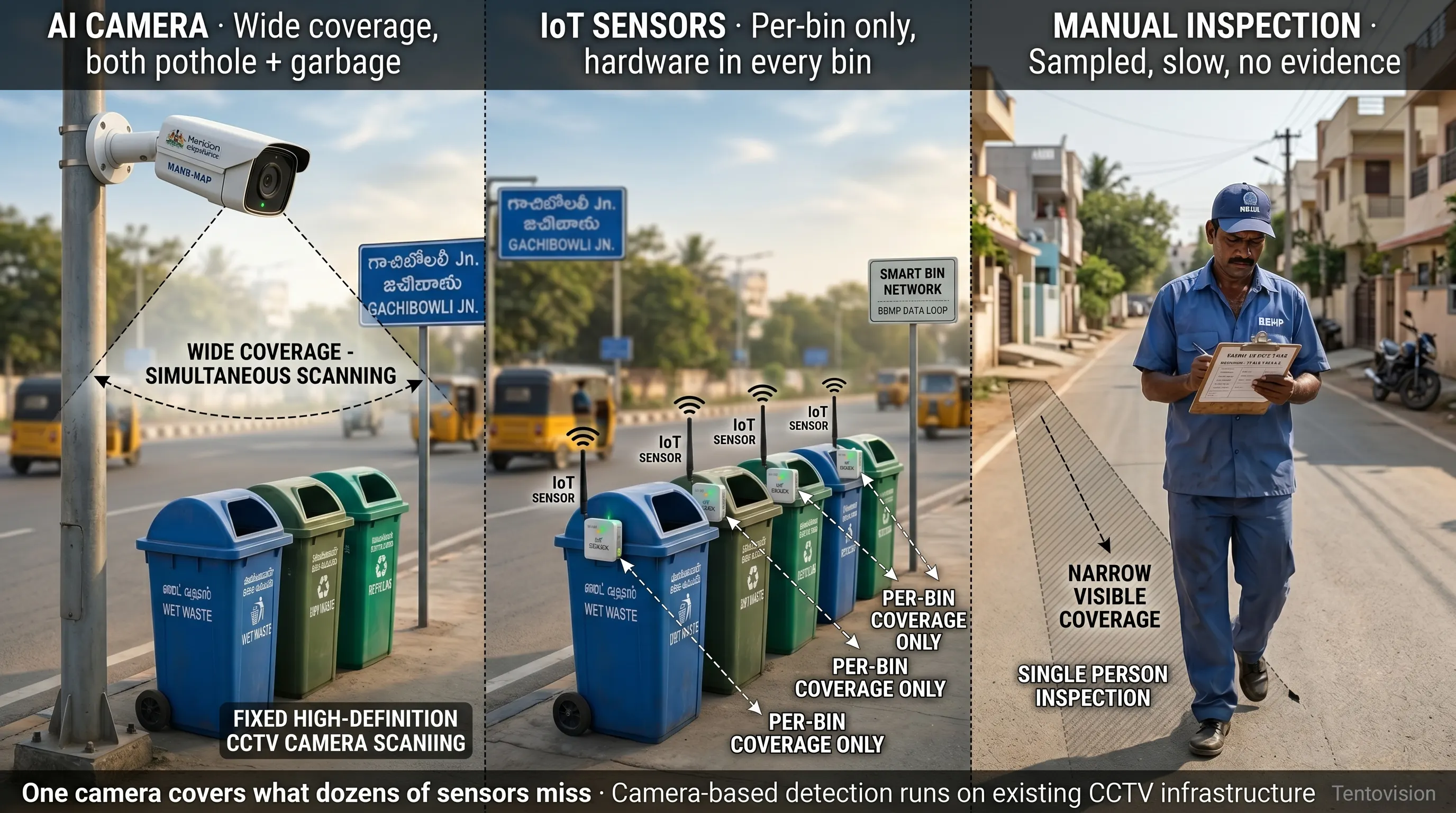
Versus sensor-based approaches — IoT fill-sensors in every bin, accelerometers in every vehicle — one camera sees overflow, dumping, littering, accumulation, and road damage across a whole area for far less hardware. Versus manual inspection, it is continuous, consistent, and covers the whole network instead of a sampled fraction.

Built for the way Indian operations actually run

The platform is designed around three operating realities: damage and dumping happen 24/7 (not just when an inspector is present), most cities and campuses already have CCTV (so adding sensors is not viable), and accountability runs through wards or zones (so every detection has to know which area owns it). The platform addresses each directly — continuous detection, ONVIF/RTSP compatibility with the cameras already in the field, and ward/zone mapping baked into every alert.

How it integrates with workflows

Detections route into the workflow that owns the response — municipal work-order systems, facility-manager mobile apps (iOS & Android), housekeeping contractor SLAs, and the smart city ICCC dashboard. It is one module of the broader AI video analytics platform, so the same cameras can run additional analytics (ANPR, fire detection, intrusion) without new hardware.
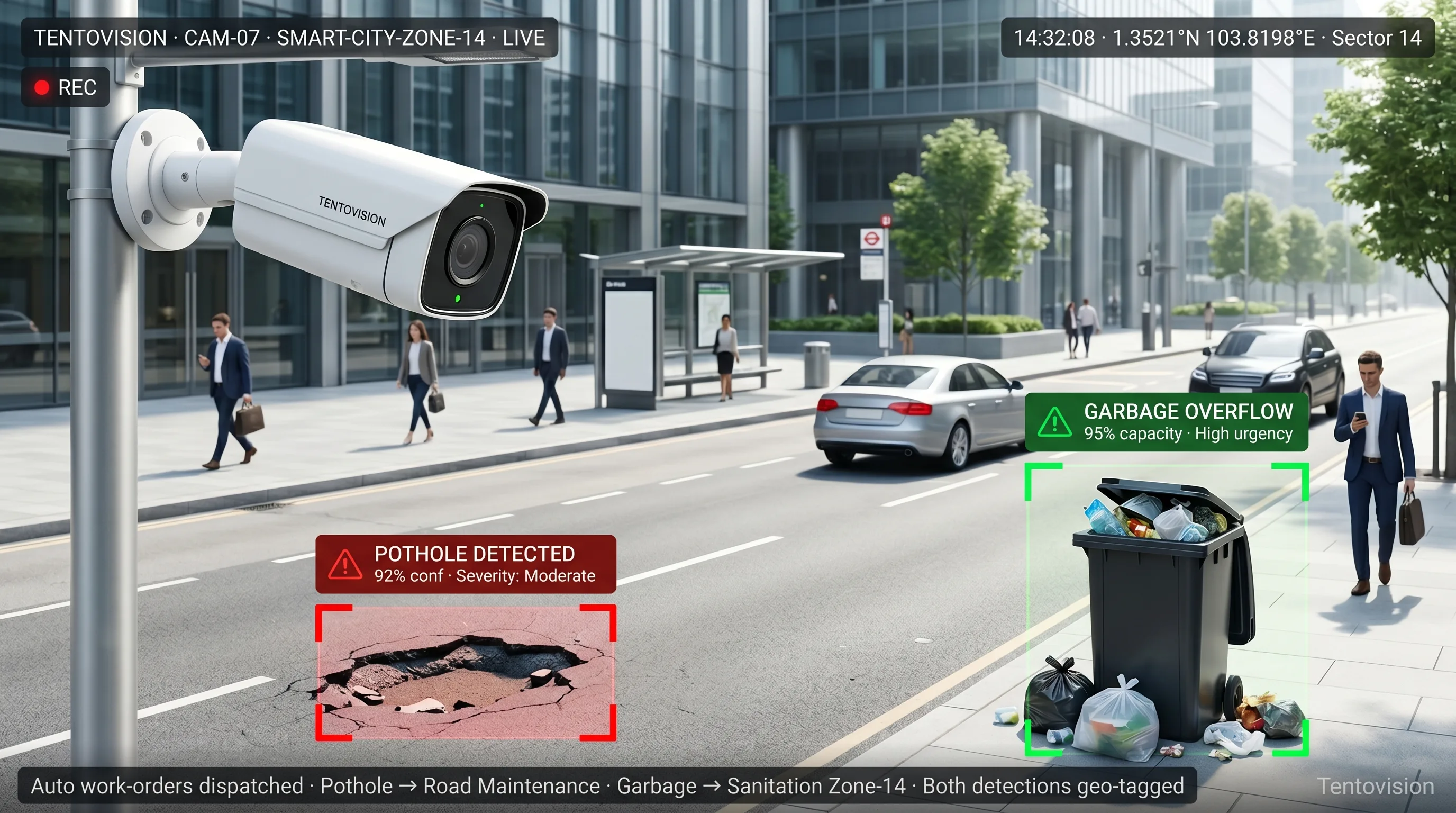

Diagram — Camera-based vs IoT vs manual
(side-by-side comparison)
Comparison of camera-based pothole and garbage detection with IoT sensors and manual inspection
Detection Capabilities

Six AI Detection Capabilities

Six capabilities make camera-based infrastructure monitoring viable end to end — three for the road, three for the waste — running on the same platform and the same cameras.

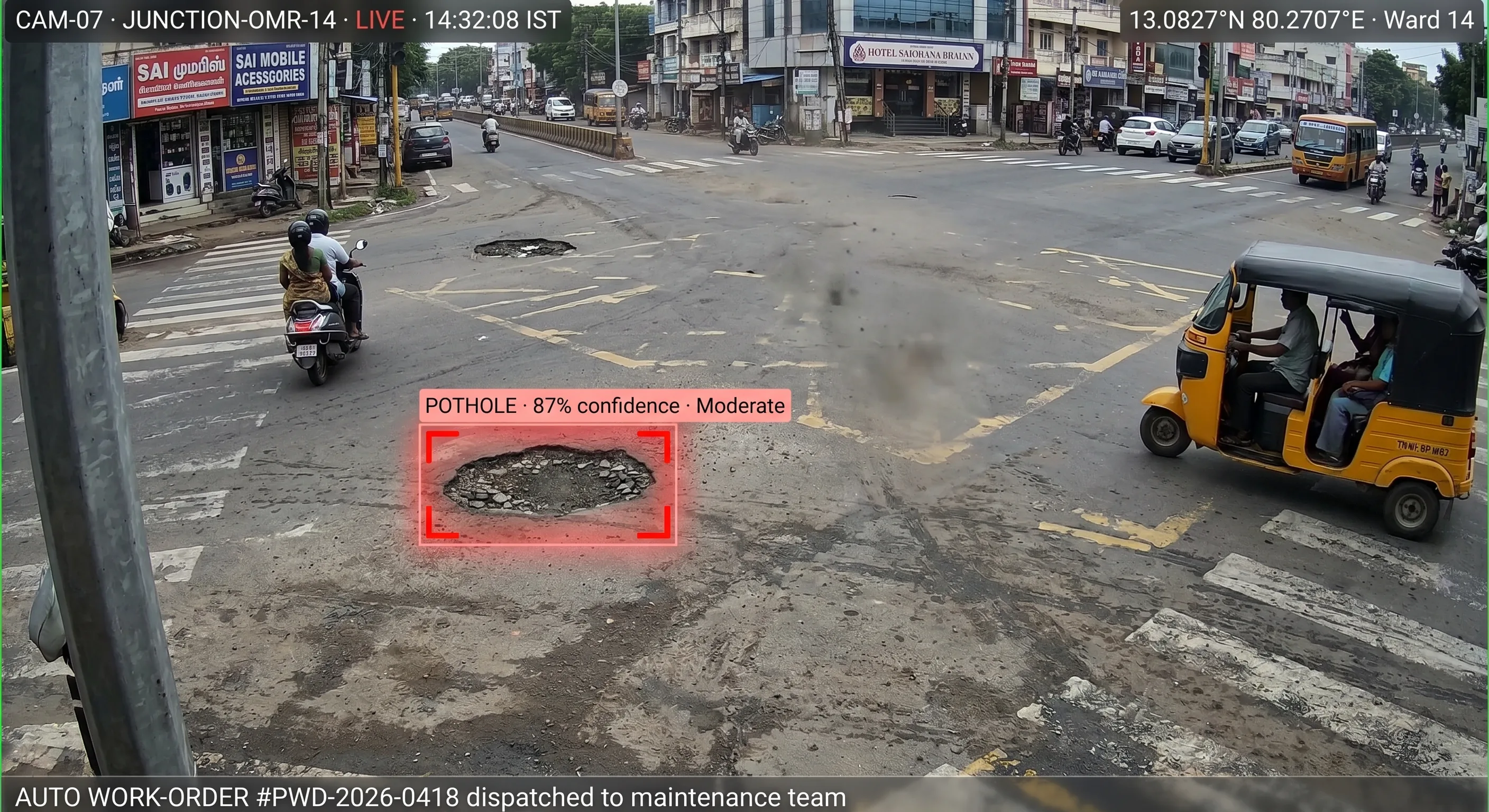
CCTV pothole image
Junction camera detecting a fresh pothole
Tentovision AI detecting a fresh pothole from a fixed junction CCTV camera with severity classification
Pothole · 01

CCTV-Based Pothole Detection

Real-time pothole detection runs on fixed road-facing cameras already deployed across a city or campus — junction, traffic, building-mounted, ONVIF/RTSP-compatible. New potholes are detected as they form at known black spots, with no new hardware required. Feeds the smart city ICCC directly via smart city video analytics.

Smart city analytics
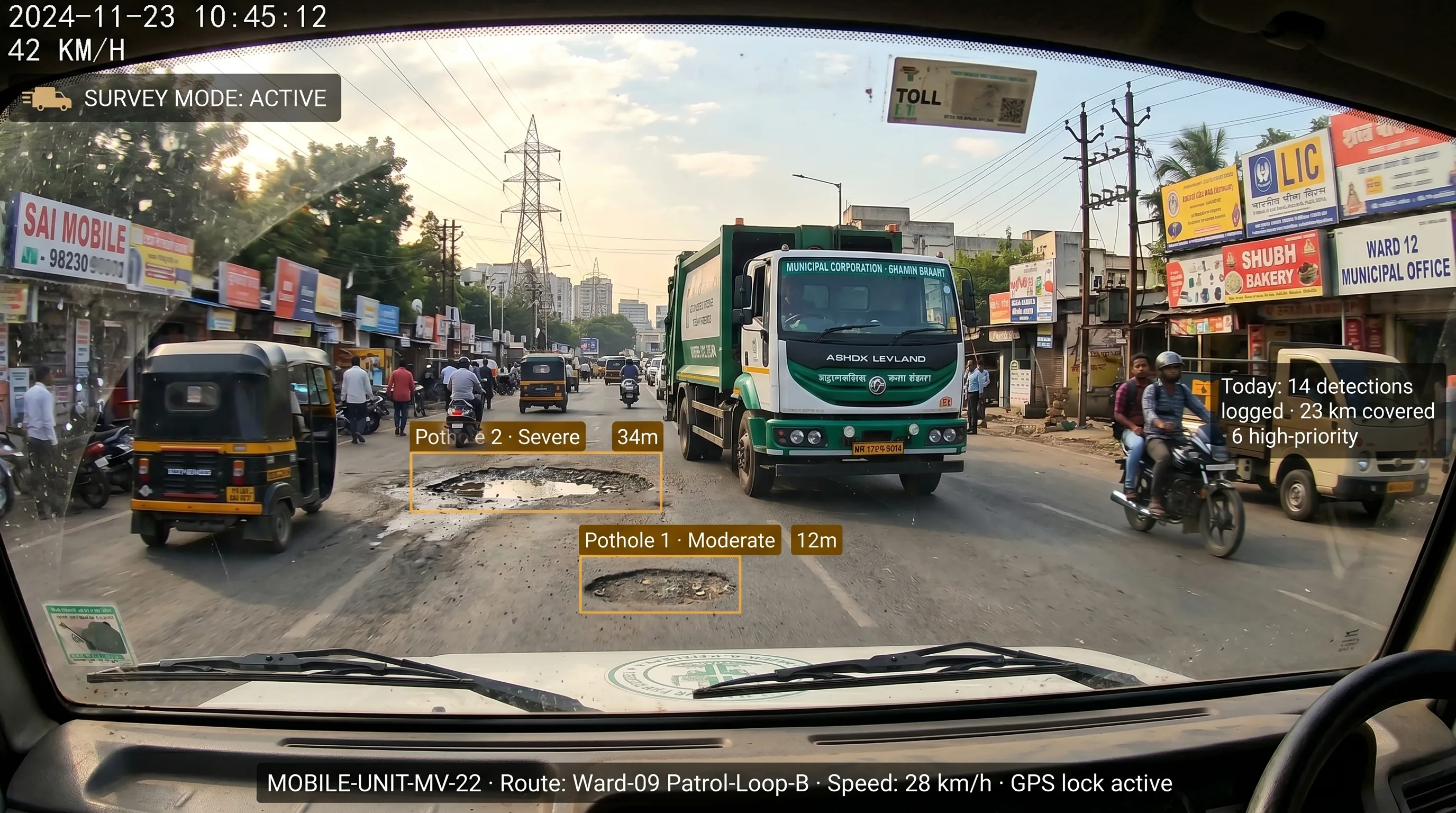
Vehicle-mounted survey image
Camera on patrol vehicle scanning road
Vehicle-mounted camera surveying road surface condition during a patrol route
Pothole · 02

Vehicle-Mounted Road Survey

For whole-network coverage, automated road condition monitoring runs from cameras on patrol cars, garbage trucks, and campus shuttles — every regular route becomes a continuous road survey. The edge device processes locally and uploads via the Cloud Adapter, so the entire network is covered as a by-product of normal operations, with no dedicated survey team.

Cloud Adapter
Severity + ward map image
Pothole pins colour-coded by severity
Geo-tagged potholes mapped by municipal ward with severity colour coding on a dashboard
Pothole · 03

Severity Classification & Ward Mapping

Pothole severity classification turns raw detections into a prioritised repair plan — minor, moderate, severe — with approximate size, GPS coordinates, and the responsible ward or zone attached to every detection. Automated work orders dispatch to maintenance teams, the dashboard shows pothole density per ward, and before/after camera verification confirms each repair was actually completed.

Multi-site monitoring
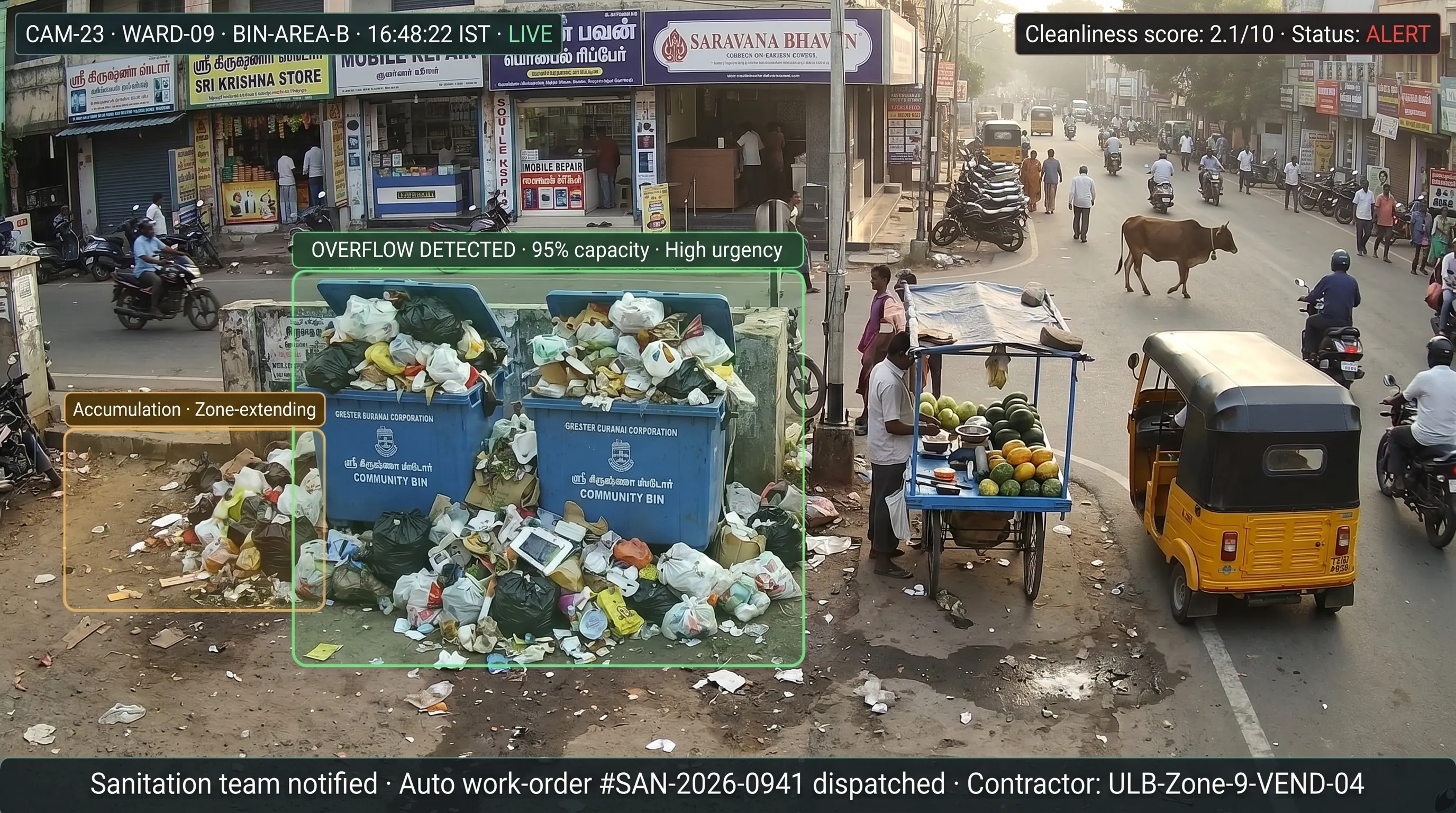
Garbage overflow image
Overflowing bin + accumulation detected
Camera-based garbage overflow and accumulation detection at a city bin area
Garbage · 04

Garbage Overflow & Accumulation

Cameras watch bin areas continuously for overflow conditions and estimate fill level from the camera feed — no IoT sensors required, works on any bin shape or size. Beyond bins, the system scores cleanliness across whole zones (clean / moderate / dirty) with trend analytics on which zones accumulate waste fastest and which times of day or week peak — post-market hours, festivals, weekly cycles.

Video management
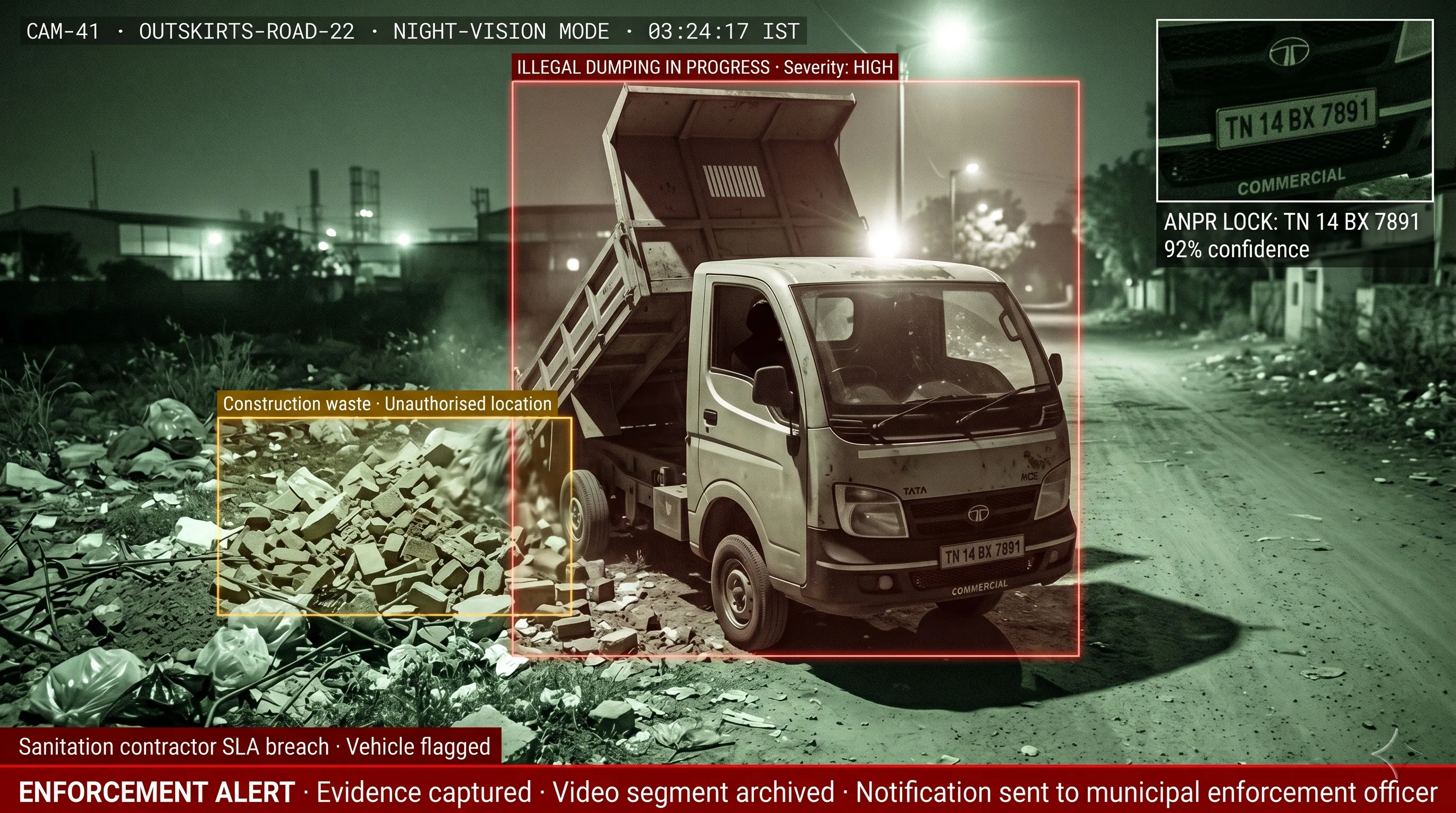
Illegal dumping image
Vehicle dumping construction debris
Illegal dumping detection capturing a vehicle dumping construction debris with ANPR
Garbage · 05

Illegal Dumping & Littering Detection

Detects waste outside designated zones — roadside debris, peripheral dumping, the act of dropping waste — including at night with night-vision cameras. Captures timestamped video evidence for fine enforcement, geo-tags each detection, and optionally reads the offending vehicle's number plate via ANPR. The visible deterrent effect reduces dumping and littering on campuses, malls, and public spaces.

ANPR for enforcement
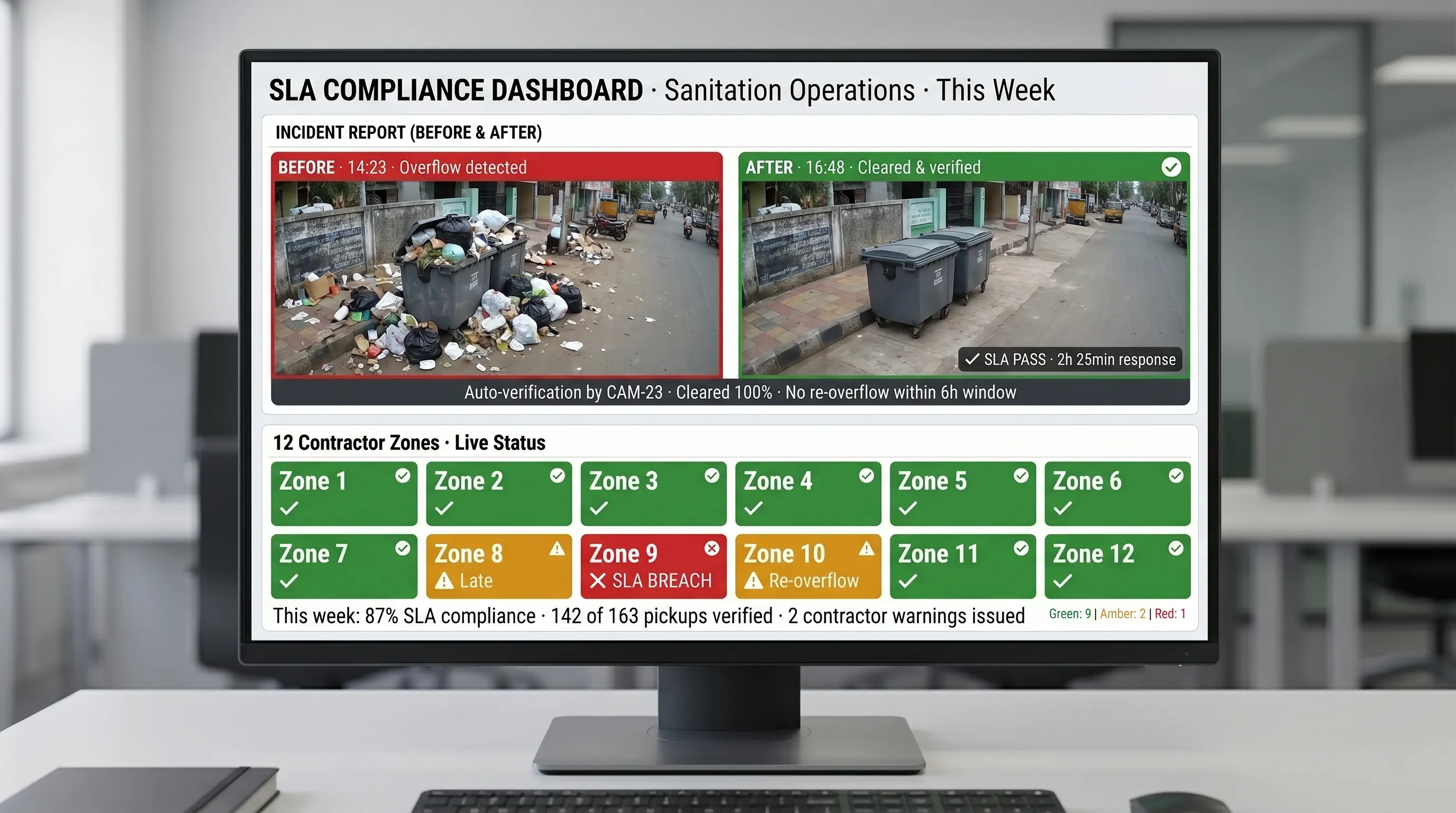
SLA dashboard image
Compliant vs failing contractor zones
Sanitation SLA compliance dashboard showing pass/fail contractor zones with before/after evidence
Garbage · 06

Sanitation SLA Compliance Tracking

Tracks contractor pickup frequency with timestamped evidence and uses before-and-after camera validation to confirm a bin area was genuinely cleared — not just visited. The SLA dashboard shows which contractor zones pass and which fail, with automated compliance reports for municipal review or private-client reporting. This turns waste-collection SLAs from a paperwork exercise into verifiable data.

Command Center
All six capabilities run on the same platform — and on the cameras you already own. Pilot a corridor or a campus first, scale across the city or estate once you've validated.
Works With Every Camera Already On Your Roads

100+ camera brands, one detection platform

Tentovision is vendor-agnostic over ONVIF and RTSP — Indian leaders (CP Plus, Sparsh, HiFocus), Chinese mass-market (Hikvision, Dahua, Uniview, Tiandy), global premium (Axis, Bosch, Vivotek, Pelco, Honeywell), plus vehicle-mounted and ordinary dashcams all run on the same platform. No rip-and-replace — drop detection onto cameras already on poles and vehicles.

HikvisionWorld #1Hikvision CCTV camera brand — works with Tentovision
DahuaGlobal Top 2Dahua CCTV camera brand — works with Tentovision
CP PlusIndian LeaderCP Plus CCTV camera brand — works with Tentovision
UniviewTier-1 ChinaUniview CCTV camera brand — works with Tentovision
Sparsh CCTVIndian OEMSparsh CCTV camera brand — works with Tentovision
HiFocusIndian BrandHiFocus CCTV camera brand — works with Tentovision
HikvisionWorld #1Hikvision CCTV camera brand — works with Tentovision
DahuaGlobal Top 2Dahua CCTV camera brand — works with Tentovision
CP PlusIndian LeaderCP Plus CCTV camera brand — works with Tentovision
UniviewTier-1 ChinaUniview CCTV camera brand — works with Tentovision
Sparsh CCTVIndian OEMSparsh CCTV camera brand — works with Tentovision
HiFocusIndian BrandHiFocus CCTV camera brand — works with Tentovision
AxisSwedishAxis CCTV camera brand — works with Tentovision
VivotekTaiwaneseVivotek CCTV camera brand — works with Tentovision
BoschGermanBosch CCTV camera brand — works with Tentovision
PelcoAmericanPelco CCTV camera brand — works with Tentovision
HoneywellAmericanHoneywell CCTV camera brand — works with Tentovision
TiandyChineseTiandy CCTV camera brand — works with Tentovision
AxisSwedishAxis CCTV camera brand — works with Tentovision
VivotekTaiwaneseVivotek CCTV camera brand — works with Tentovision
BoschGermanBosch CCTV camera brand — works with Tentovision
PelcoAmericanPelco CCTV camera brand — works with Tentovision
HoneywellAmericanHoneywell CCTV camera brand — works with Tentovision
TiandyChineseTiandy CCTV camera brand — works with Tentovision
India-Specific

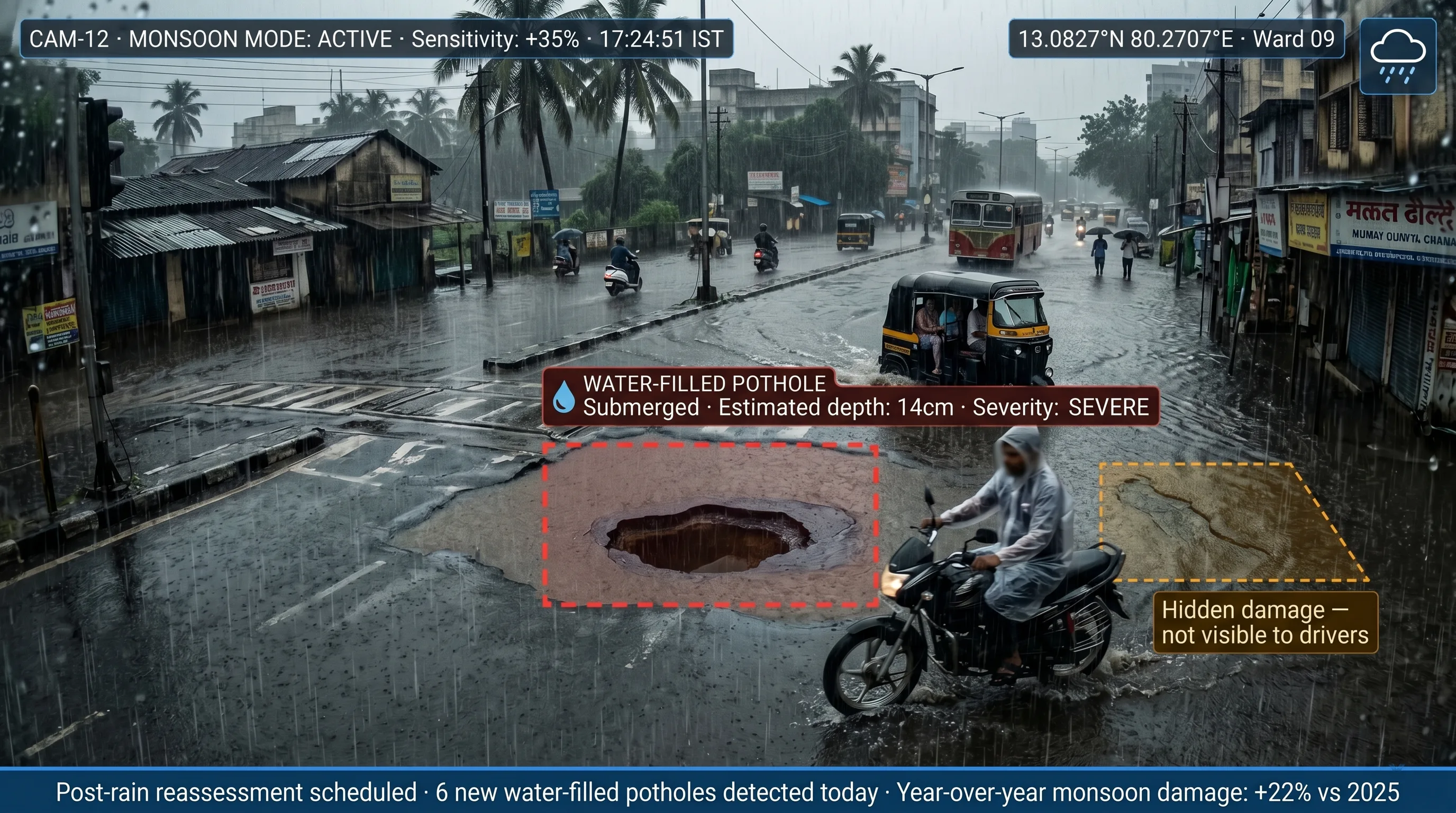
Built for the Monsoon

The genuinely India-specific capability — because monsoon is when potholes multiply, water hides damage, and most road incidents spike. No imported platform handles this.

Monsoon Mode

Detect what drivers cannot see

A genuinely India-specific monsoon mode raises detection sensitivity from June to September, catches partially water-filled potholes that drivers cannot see until impact, and reassesses every road stretch after each spell of rain.

  • Increased detection sensitivity through monsoon months (configurable per region)
  • Water-filled pothole detection for partially submerged road damage
  • Post-rain road-condition reassessment after each spell — automatic re-scoring
  • June–September tracking with year-over-year comparison across the same stretches
  • Feeds the same dashboard, same alerts, same work-order workflow — just turned up for the monsoon

Monsoon mode is what separates a road-monitoring product designed for India from one repackaged from a European or American template.

Feature image — Monsoon mode detecting
a water-filled pothole on an Indian road
Tentovision monsoon mode detecting a partially water-filled pothole on a flooded Indian road
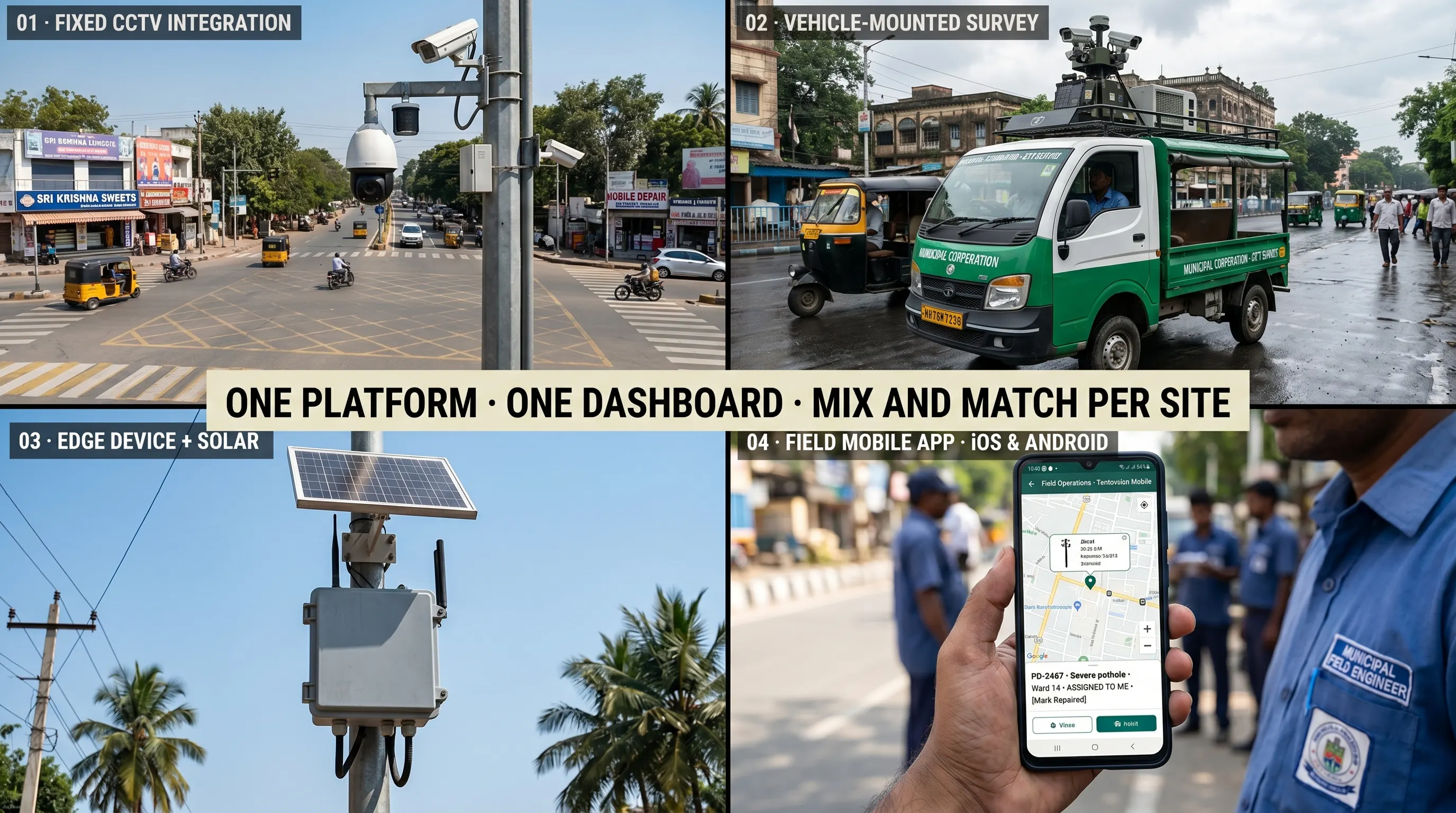
Deployment Flexibility

Fixed CCTV, vehicle-mounted, edge + solar, mobile app — pick what fits the site

The platform meets the infrastructure where it is — which is what lets one product serve a smart city, a state PWD, an IT park, and a hospital from the same codebase.

  • Fixed CCTV integration — existing junction, road, and campus cameras over ONVIF/RTSP via the VMS platform
  • Vehicle-mounted cameras — on patrol cars, garbage trucks, and campus shuttles — everyday routes become continuous road surveys
  • Edge device + solar — standalone detection stations for unmanned stretches and remote campuses with poor connectivity; AI runs locally, syncs to Microsoft Azure India cloud when online
  • Dashcam survey mode — any vehicle with a dashcam becomes a road-survey unit, no fixed install required
  • Mobile app for field teams — iOS and Android — work-order acceptance, on-site verification, before/after photo evidence, geo-tagged updates from the maintenance crew

All five modes feed the same dashboard, same work-order workflow, same ward-mapped analytics. Mix and match per site.

Feature image — Fixed + vehicle + edge + mobile app
one dashboard, one platform
Tentovision deployment flexibility — fixed CCTV, vehicle-mounted, edge-solar, mobile app feeding one dashboard
Why Tentosoft

Why Infrastructure Buyers Choose Tentovision

The only platform that detects both potholes and garbage on the cameras you already have — engineered, priced, and supported from India.

Camera-Based, Not Sensor-Based

No IoT fill-sensors in every bin, no accelerometers in every vehicle — it runs on the cameras you already have. One camera covers what dozens of sensors couldn't.

Dual Detection, One Platform

Potholes and garbage from a single platform and dashboard — the pairing no competitor combines. One vendor, one contract, one support team for both modules.

Works With Existing CCTV

100+ brands over ONVIF/RTSP; pair with camera health monitoring to keep every detection camera online — no detection blackouts.

Edge-First for Poor Connectivity

Detection runs locally on the edge device, so rural roads and remote campus stretches are covered without a constant cloud link. Solar-powered options for off-grid sites.

Geo-Tagged with Ward Mapping

Every detection carries GPS and a responsible ward or zone — the foundation of municipal accountability and private SLA tracking. Automated work orders, before/after verification.

India-Built, India-Priced

Engineered and supported from Chennai, priced for Indian budgets. Edge device from ~₹6,000 (indicative); see pricing. No foreign-product premium.

Government

Government & Municipal Deployment Scenarios

Built for municipal corporations, smart city SPVs, and state highway and rural-road authorities — designed to fit existing procurement, reporting, and accountability workflows.

Smart City ICCC Road & Waste Dashboard

Both modules feed a unified pothole-and-garbage view inside the ICCC, so operators see road damage and waste hotspots on the same city map as every other analytic.

Municipal Ward-Level Road Monitoring

Geo-tagged potholes mapped to each ward give councillors and engineers clear accountability — density per ward, automated work orders, before/after verification across the multi-site network.

Swachh Bharat Compliance Monitoring

Automated garbage-pickup verification, cleanliness scoring by zone, and illegal-dumping alerts give a measurable, auditable basis for sanitation performance — designed to support Swachh Bharat goals.

Highway & PMGSY Post-Monsoon Assessment

Vehicle-mounted survey mode re-scans highway and PMGSY rural-road stretches at scale after the monsoon, prioritising the worst damage — designed for state PWD and highway-authority workflows.

Private Enterprise

Private Campus & Enterprise Deployment Scenarios

On your existing campus CCTV — automated road and waste monitoring with SLA proof, replacing daily manual walkthroughs that don't scale.

IT Parks & Tech Campuses

Internal road monitoring plus waste-bin management across multiple buildings, with cleanliness scores supporting LEED/IGBC certification and SLA proof against housekeeping vendors.

Townships, Malls & Mixed-Use Estates

Road-quality monitoring, public-area cleanliness scoring, and garbage-SLA tracking against waste vendors — protecting resident and visitor experience, complementing crowd analytics on the same cameras.

Hospitals

Biomedical-waste-zone monitoring for regulatory compliance plus campus road maintenance, on the enterprise platform with healthcare-grade governance and audit trails.

Industrial Estates & Manufacturing

Factory-road maintenance, waste-segregation-area monitoring, and pollution-control-board compliance evidence — all from existing plant CCTV, no new sensor infrastructure.

Comparison

Why AI Camera Detection Beats IoT Sensors and Manual Inspection

Every approach has a structural trade-off. Cameras are the only approach that covers both roads and waste on infrastructure that already exists.

Approach Both Detections Coverage Per-Unit Hardware Offender Evidence Geo-Tagged Scalability
Manual inspectionHumanSampledNonePhoto-onlyManualLow
Citizen complaintsReactiveSpottyNoneHearsayApp-basedLow
IoT bin fill-sensorsWaste onlyPer-binHigh (every bin)NoneYesMedium
Vehicle accelerometer (potholes)Road onlyPatrol routesHigh (every vehicle)NoneYesMedium
LiDAR road surveyRoad onlySurvey runsVery highNoneYesLow
AI Camera (Tentovision)Both modulesWhole networkNone (existing cameras)Video evidenceYes (+ward)High

Manual inspection samples a fraction of the network and finds damage after the fact; citizen complaints react to the problems already noticed; IoT bin sensors give precise fill numbers but only per bin, with hardware in every bin; vehicle accelerometers cover patrol routes only and need install in every vehicle; LiDAR is expensive and scheduled. AI camera detection covers the whole network on infrastructure already deployed, runs both road and waste modules on the same feed, and produces video evidence for enforcement and verification.

Proven AI · New Vertical

Proven AI. New Vertical.

Tentovision is honest about where this stands: the pothole and garbage modules are a new application of an AI engine already deployed across 500+ enterprise sites. We don't claim existing municipal road or waste contracts — the underlying technology is battle-tested. Pilot first, validate, then scale.

Real-time detection speed

Fire detected in under 5 seconds at Nippon Paint manufacturing plants — the same real-time detection-and-alert pipeline that powers pothole and garbage detection.

— Nippon Paint India, fire & smoke detection (verified with permission)

Multi-site centralized monitoring

500+ cameras managed centrally at Narayana Health across multiple hospitals — the same dashboard a city or campus needs for ward-level oversight.

— Narayana Health, centralized VMS (verified with permission)

Outdoor / rugged edge AI

Edge-AI deployment at STT GDC India construction sites — the same rugged, on-site processing that road and waste modules require.

— STT GDC India, edge AI at construction scale (verified with permission)

Multi-brand camera compatibility

100+ camera brands integrated via ONVIF/RTSP across enterprise deployments — the same compatibility that lets pothole and garbage detection run on whatever cameras you already have.

— Verified across enterprise deployments

Infrastructure-relevant by design. The same AI engine that detects fire in under 5 seconds powers Tentovision's pothole and garbage detection. We recommend starting with a pilot of 10–20 cameras on a road stretch or a single campus to validate accuracy in your conditions before any city-wide or estate-wide rollout — same platform, same vendor, same support team.

500+
Enterprise deployments
2-in-1
Pothole + garbage
100+
Camera brands
Ward-Level
Geo-tag mapping
iOS & Android
Field-team app
India
Based support
Compliance

Regulatory Alignment

Designed to align with the frameworks that govern roads, waste, and data in India. Treat each label as "internal controls map to this framework", not "third-party certified" — full attestation documents are issued per project on request.

Smart Cities Mission

Designed to support infrastructure-monitoring requirements and ICCC integration.

Swachh Bharat Mission

Designed to support waste-management and cleanliness scoring goals.

SWM Rules 2016

Solid Waste Management Rules — designed to support segregation and collection monitoring.

PMGSY

Designed to support rural-road quality-monitoring workflows.

LEED / IGBC

Campus cleanliness scoring designed to support certification documentation for private estates.

DPDP Act 2023

Data privacy and governance for camera footage; audit trails, RBAC, retention controls.

ISO 27001 · SOC 2 Aligned

Information-security practices mapped to ISO/IEC 27001 controls and SOC 2 Type II.

VAPT Aligned

Internal vulnerability assessment and penetration testing programme.

FAQ

Frequently Asked Questions

What infrastructure buyers actually ask before they pilot.

What is an AI pothole detection system?

An AI pothole detection system uses computer vision on CCTV or vehicle-mounted camera feeds to automatically detect road damage, classify its severity, and record its GPS location in real time. Instead of waiting for accidents or citizen complaints, it continuously surveys the road network and sends geo-tagged alerts to maintenance teams. Fixed cameras cover known black spots while cameras on patrol or garbage vehicles survey the whole network during normal routes.

How does AI garbage detection using CCTV work?

AI models analyse camera feeds to recognise overflowing bins, scattered waste accumulation, and illegal dumping, then send a geo-tagged alert to the sanitation team. The same system can detect the act of littering or dumping and capture timestamped video evidence, optionally reading the offending vehicle's number plate via ANPR for enforcement. It runs on existing CCTV, so there is no need to install sensors in every bin.

Can it detect potholes during monsoon season?

Yes, and monsoon is precisely when it matters most, because potholes form fastest and are often hidden under water. The system runs a monsoon monitoring mode with heightened sensitivity, including detection of partially water-filled potholes that drivers cannot see, and it reassesses road condition after each spell of rain. It also tracks June to September deterioration year over year so cities can compare monsoon damage across seasons.

Does it work with existing CCTV cameras?

Yes. Tentovision is vendor-agnostic over ONVIF and RTSP, so it works with the junction, traffic, building, and campus cameras already installed — Hikvision, Dahua, CP Plus, Axis, and others — without rip-and-replace. It also supports cameras mounted on vehicles and ordinary dashcams. Using existing infrastructure is what keeps deployment affordable.

Is it suitable for private campuses and IT parks?

Yes. The same platform monitors internal roads and waste bins across IT parks, residential townships, malls, hospitals, and industrial estates using their existing CCTV. Facility managers get automated pothole and overflow alerts, a cleanliness score per zone, and SLA proof against housekeeping or waste contractors — replacing daily manual walkthroughs, and supporting LEED/IGBC cleanliness documentation where required.

How is camera-based garbage detection different from IoT bin sensors?

IoT fill-level sensors give a precise fill percentage but only for the single bin they are installed in, and they require hardware in every bin plus ongoing battery and maintenance. Camera-based detection covers overflow, illegal dumping, littering, and area accumulation across a whole zone on existing CCTV, and adds road monitoring on the same feed. The honest trade-off is that sensors give exact per-bin fill numbers, while cameras give far broader coverage, offender evidence, and lower hardware cost.

Can it track whether garbage was actually collected?

Yes. The system tracks contractor pickups with timestamped evidence and uses before and after camera validation to confirm a bin area was genuinely cleared, not just visited. An SLA dashboard shows which contractor zones are compliant and which are failing, with automated reports for municipal review or private-client reporting. This turns waste-collection SLAs from a paperwork exercise into verifiable data.

Does it provide geo-tagged reports for municipal ward mapping?

Yes. Every pothole and garbage detection is tagged with GPS coordinates and mapped to the responsible municipal ward or campus zone. The dashboard shows defect and waste density per ward so administrators can see exactly where attention is needed, and automated work orders route to the right maintenance team. This ward-level accountability is one of the most valued features for municipal buyers.

What is the cost of a pothole and garbage detection system?

Cost depends on the number of cameras, whether vehicle-mounted units are added, and the deployment scale, so it is quoted per project. Because the system runs on existing CCTV and needs no per-bin sensors, it is typically far cheaper than IoT or LiDAR alternatives, and both modules run on one platform; the Tentovision Edge Device starts at around ₹6,000 (indicative). Pricing is transparent and project-specific, and a pilot lets you validate value before scaling. See pricing.

Can I start with a pilot project?

Yes, and it is the recommended approach. A pilot of 10 to 20 cameras on a road stretch or a single campus validates detection accuracy in your specific conditions — lighting, camera angles, road and waste types — before any city-wide or estate-wide rollout. The pilot produces real detection data and geo-tagged evidence you can evaluate, and it scales seamlessly into full deployment on the same platform.

Pilot Project

Pilot Pothole & Garbage Detection on Your Cameras

Tell us a corridor, a ward, or a campus you'd like to pilot. We'll review your existing CCTV, recommend the right module mix (CCTV-based, vehicle-mounted, edge+solar, mobile app), and design a 10–20 camera pilot you can validate before any city-wide or estate-wide rollout.

1

Site walkthrough & camera audit

We assess your existing CCTV and identify which feeds suit pothole vs garbage detection.

2

Pilot scoping (10–20 cameras)

One corridor or one campus, both modules running, validated for accuracy in your conditions.

3

Geo-tagged evidence & SLA report

Real detections, ward-mapped, with before/after verification — proof you can take to procurement or facility management.

4

Scale plan & transparent pricing

Edge from ₹6,000 (indicative); detection deployments quoted per project. Same platform scales city-wide or estate-wide.

Direct contact Tentosoft Solutions Private Limited
7th Floor, 4/293, RAR Technopolis, OMR, Perungudi, Chennai 600096
+91 99620 37023 · info@tentosoft.com

Request a Pilot Project

We'll get back within one business day with a site-fit and pilot scope.

🔒 Microsoft Azure India · DPDP Act 2023 compliant
✓ Reply within one business day · No spam